


How to get into rehab in Ohio, step by step
Getting into treatment in Ohio usually takes six steps: deciding how urgent it is, an assessment, sorting out payment, choosing a program, preparing for admission and planning what comes after. SAMHSA lists 747 addiction treatment facilities in Ohio (November 5, 2026)[1].
Key takeaways
- 695 of 747 listed programs accept Ohio Medicaid; 330 use a sliding fee scale.
- 105 offer medical detox and 133 offer residential or inpatient care.
- If you have no insurance, every Ohio county has a local board that funds treatment.
- Signs of overdose or dangerous withdrawal mean calling 911 first, not a program.
Step 1: Decide how urgent it is
Some situations need emergency care before any program. Call 911 for signs of an overdose: slow or stopped breathing, blue lips, or someone who cannot be woken. Call 911 for severe withdrawal: seizures, confusion or hallucinations after stopping alcohol or sedatives. For thoughts of suicide, call or text 988, the Suicide & Crisis Lifeline, at any time[7].
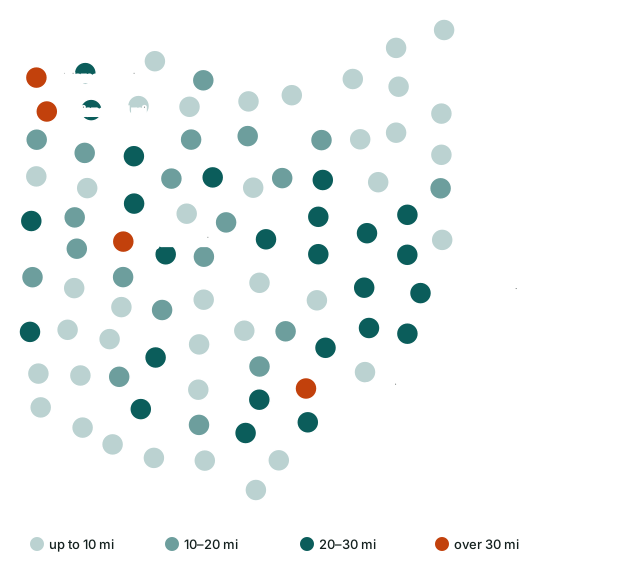
If you drink heavily every day or take benzodiazepines daily, do not stop suddenly on your own. Withdrawal from these can be dangerous, and medically supervised detox is the safe start. 105 programs in Ohio offer it; see detox programs by city. Distance matters: in some counties the nearest listed detox is a long drive away.
Step 2: Get an assessment
An assessment is a conversation with a counselor or clinician about what you use, your health, your mental health, past treatment and your home life. Programs use it to set the level of care with the ASAM criteria, the standard framework for addiction treatment[2]. You do not need to arrange it separately: most programs do it at the first visit or on the phone.
The level of care that comes out of it is usually one of these:
- Outpatient: sessions once or twice a week while you keep working. 673 programs here.
- Intensive outpatient or day treatment: several hours a day, most days. 193 intensive outpatient and 188 day programs.
- Residential or inpatient: you live at the program with staff around the clock. 133 programs.
- Medication for opioid use disorder: buprenorphine, methadone or naltrexone, often alongside counseling. 308 programs.
| Level of care | Programs | Accept Medicaid | Sliding fee |
|---|---|---|---|
| Outpatient | 673 | 647 | 309 |
| Intensive outpatient | 193 | 186 | 85 |
| Day program (PHP) | 188 | 182 | 73 |
| Residential | 133 | 124 | 48 |
| Medical detox | 105 | 98 | 44 |
| Medication (MAT) | 308 | 279 | 130 |
To prepare, our private self-check walks through the same criteria and dimensions.
Step 3: Sort out how you will pay
Most treatment in Ohio is covered. 695 of the 747 listed programs accept Ohio Medicaid, 623 accept private insurance and 554 accept Medicare[1]. Ohio expanded Medicaid, so adults with low income can qualify[3].

With private insurance, ask your plan three things before admission: your deductible and coinsurance for the level of care, whether prior authorization is needed, and whether the program is in network. If the plan denies care, you can appeal, and an urgent appeal is decided within 72 hours[5]. Our cost calculator turns a program's quote into your share.
Without insurance, start with your county's local board. Every Ohio county is covered by an ADAMH board or a Mental Health and Recovery Services board that funds treatment for residents who cannot pay[4]. 330 programs also use a sliding fee scale; see free and low-cost programs.
Step 4: Choose a program
Listings do not show openings, and they change daily. Narrow the list first: our directory of all 747 facilities groups them by city, and each city page filters by detox, residential care, medication, Medicaid, teens and Spanish. Then call. When you reach a program, ask:

- Do you treat what I use, and any mental health condition at the same time?
- Do you take my insurance or my Medicaid plan, and what will I owe?
- When can you admit me, and what can I start while I wait?
- Are you licensed by the state, and accredited by CARF or the Joint Commission?
- What happens when the program ends?
Ask each program directly about space; its listing links to its own website.
Step 5: Prepare for admission
Bring your ID, insurance or Medicaid card, a list of your medications and prescriptions, and the name of anyone the program may contact. For residential care, ask what to pack and what is not allowed.
If you work, the Family and Medical Leave Act can protect your job for up to 12 weeks of unpaid leave if you and your employer qualify[6]. Ask human resources about short-term disability for pay.
Step 6: Plan what comes after
Treatment does not end at discharge. Most people step down from residential care to day treatment or outpatient sessions, and continue medication if they take it. Ask the program before you leave who your next appointment is with, and whether it offers recovery support such as peer mentoring, housing help or employment services. Many Ohio programs list these with SAMHSA[1], and each facility page on this site shows which ones it offers.

Not sure where to start?
Getting a loved one into treatment, or yourself? Read on, or contact a program directly.
Paid referral line, answered by a partner, not by a program listed here.
Sources
- SAMHSA FindTreatment.gov (facility data). findtreatment.gov
- ASAM. The ASAM Criteria. www.asam.org
- Ohio Medicaid. medicaid.ohio.gov
- Ohio Department of Behavioral Health. County boards. dbh.ohio.gov
- HealthCare.gov (CMS). Appealing a health plan decision. www.healthcare.gov
- U.S. Department of Labor. Family and Medical Leave Act. www.dol.gov
- 988 Suicide & Crisis Lifeline. 988lifeline.org
Facility counts come from the SAMHSA snapshot of November 5, 2026.
Last checked November 5, 2026 by the Ohio Rehab editorial team against the sources above. How we work.
How to get into rehab in Ohio, step by step
Questions
How fast can I get into rehab in Ohio?
Outpatient programs and medication for opioid use can often start within days. Detox and residential beds depend on openings, which change daily; ask each program about openings before you travel.
Do I need a referral from a doctor?
Usually not.
Details: do i need a referral from a…
Most programs accept people who call them directly and do their own assessment. Some insurance plans require a referral or prior authorization, so ask your plan.
Can I get treatment without insurance in Ohio?
Yes. 330 listed programs price by income, 521 report public funding, and your county's local board funds treatment for residents who cannot pay.
What if the program has a waiting list?
Ask what you can start while you wait, such as counseling or medication, and ask other programs too. Programs funded by the federal block grant give priority to pregnant women and people who inject drugs.